Where Are Tessellations Found in Art Where Are Tessellations Found in Nature
When we think of the term tessellation fine art, for many of united states of america the beginning images that come to mind are the M.C. Escher tessellations and his other artwork containing optical illusions. However, tessellation patterns are a very specific kind of optical illusion that involves not simply bending our perspective but specifically the use of repeating patterns and motifs in a piece of art. And then, what is tessellation, and which are the best examples of tessellation art and tessellating artists? Let us observe out.
Table of Contents
- 1 A Definition of Tessellation
- one.1 A Cursory History of Tessellation Patterns
- 2 Tessellation Patterns in Art
- 2.1 Famous Tessellating Artists
- 2.2 Famous Tessellation Artworks
- iii Often Asked Questions
- 3.one Is All of M.C. Escher'south Work Considered to Be Tessellation Art?
- 3.ii Are People Still Creating Tessellation Fine art Today?
A Definition of Tessellation
What is Tessellation? Tessellation art is created through the process of roofing a surface with a number of geometric shapes that fit together almost like a jig-saw puzzle, never overlapping and leaving no spaces between them. As well known every bit tiling, this process results in a mosaic pattern that can be used in a highly creative manner, despite its largely confining mathematical construction.
The use of tessellation ideas and concepts throughout our history has resulted in the creation of beautifully decorated architecture, such equally temples and mosques, as well every bit magnificent works of art.
A Brief History of Tessellation Patterns
An understanding of aboriginal languages in history tin can help one better understand the tessellation definition. The word derives from the Latin word tessellātus (square minor stones) and the Greek word tessera (four). This hints at the historical utilise of tessellation ideas that stretch far back into our history when pocket-size tiles made of glass, rock, or clay were used to create patterns on public and domestic surfaces.
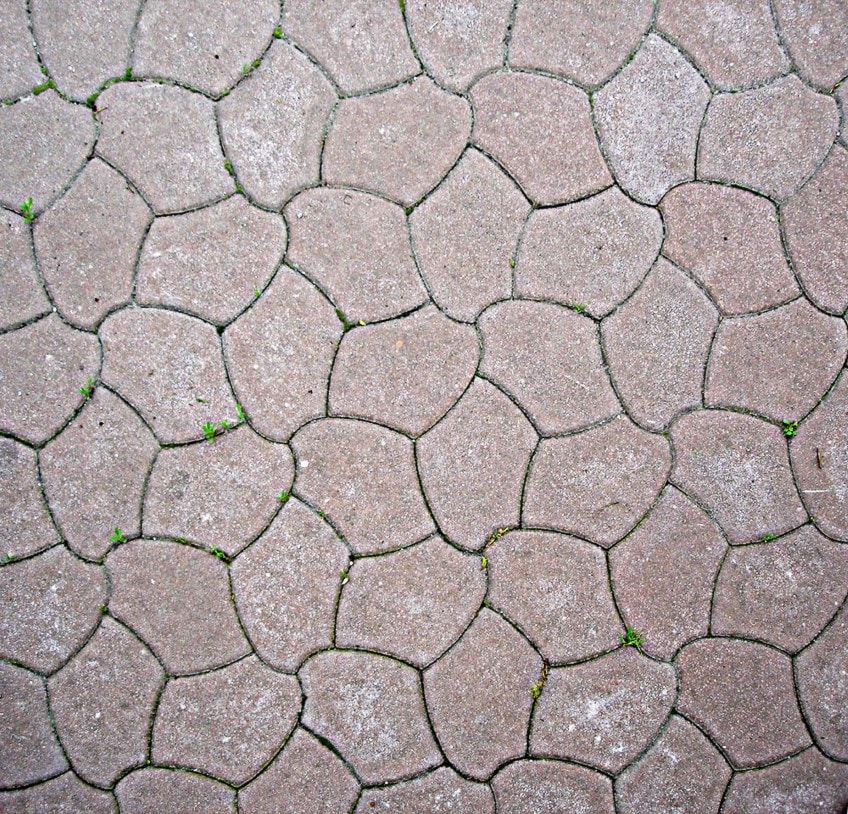 Tessellation pattern of a street pavement in Zakopane, Poland; Dmharvey, Public domain, via Wikimedia Eatables
The Origins of Tessellation Art
The use of tessellation patterns in temples and homes tin can be traced back to sometime in iv,000 BC in Sumeria. Modern archeologists accept uncovered many beautiful examples of tessellation art created past the Sumerian civilization, where it then spread to many other ancient civilizations such as the Romans, Chinese, Greek, Egyptians, Arabs, Moors, and Persians.
Many of these designs have regional characteristics, which make them unique to the people and civilisation they originated from.
Not but was the geometry of tessellation patterns fascinating to the tessellating artists, just intellectuals too began to show a deep interest in the mathematical structure of these tessellating patterns found from the Centre Ages and through the 19th century.
Tessellation Art in Islam
The finest examples of tessellation patterns in compages and art can be found in Islam. Specifically the regions of North Africa, Maghreb, and the Iberian Peninsula during the Middle Ages. Islamic art forbids the representation of living forms, so it was the perfect surroundings for a fashion to develop that was based on the application of geometric shapes.
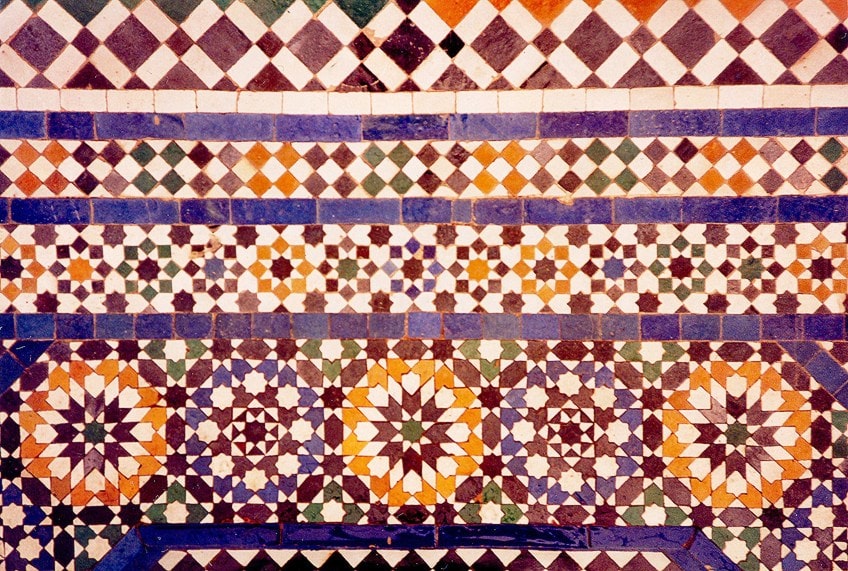 Islamic zellige mosaic ceramic tile tessellations in Marrakech, Morocco;Ian Alexander, CC Past-SA iii.0, via Wikimedia Eatables
Aside from applying stylistic tessellation ideas to their architecture, they also designed their pottery and textiles with tessellation patterns. These tessellating artists employed a style called "zellige", which had its roots in the Islamic belief in universal intelligence, the artists tried to portray the laws that preside over the universe.
Tessellation Patterns in Art
Earlier we can further discuss examples of tessellation fine art, it is important to mention the intrinsic connection between art, mathematics, and science. No matter which schoolhouse of thought nosotros wish to view tessellation through, the common thread throughout is a desire to apply diverse techniques to help better understand and limited the world around us.
It is easy to draw hard distinctions betwixt tessellating artists, mathematicians, and scientists, simply in each field of expertise, these lines become blurred when dealing with the bailiwick of geometrically based art forms.
Artists employ a multitude of mathematically based techniques to create works of fine art that are pleasing to the eye because they speak straight to our subconscious appreciation of symmetry. Diverse tools such as the Golden Ratio are often used in artworks to represent the underlying divine ratio in nature. The history of corking fine art is total of examples of works that have used geometrical patterns repetitively to create stimulating and stunning masterpieces.
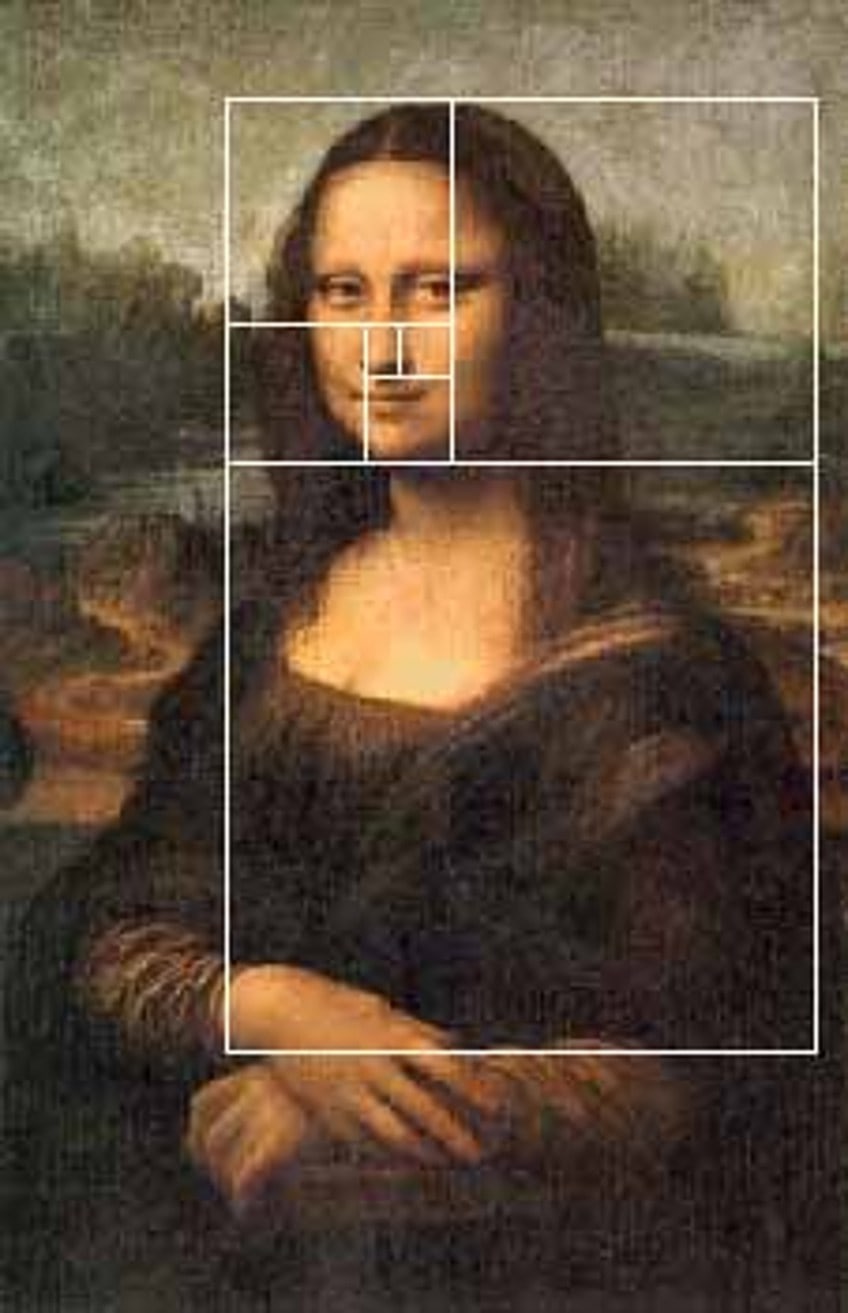 The Golden Ratio as seen in The Mona Lisa (1503-1505) by Leonardo da Vinci; Leonardo da Vinci, Public domain, via Wikimedia Commons
Famous Tessellating Artists
Artists have used tessellation ideas in their compages and art since earlier written history, so many of the primeval examples of tessellation patterns establish in temples and tombs are not accredited to any specific artist. Notwithstanding, in more than contempo years, several artists have get world-renowned for their unique application of patterns in tessellation art. The most well-known of these artists is nearly undoubtedly the chief M.C. Escher, renowned for his piece of work which explored the employ of patterns in his artwork to distort the subjective experience of the viewer.
Let us offset our exploration of tessellating artists with the master himself.
M.C. Escher (1898 – 1972)
Escher was born in Leeuwarden in the Netherlands on the 17th of June 1898. This famous Dutch graphic artist worked in mediums such every bit mezzotints, lithographs, and woodcuts to create artworks that were mathematically inspired. Besides tessellation patterns, his work also featured other mathematically based concepts such equally hyperbolic geometry, impossible objects, perspective, symmetry, reflection, and infinity.
Escher had no background in mathematics, nor did he believe that he had whatsoever mathematical power, yet he often conversed with mathematicians such as Roger Penrose, Harold Coxeter, as well as Friedrich Haag (a crystallographer) also every bit carried out personal enquiry into the application of tessellation patterns inside his art.
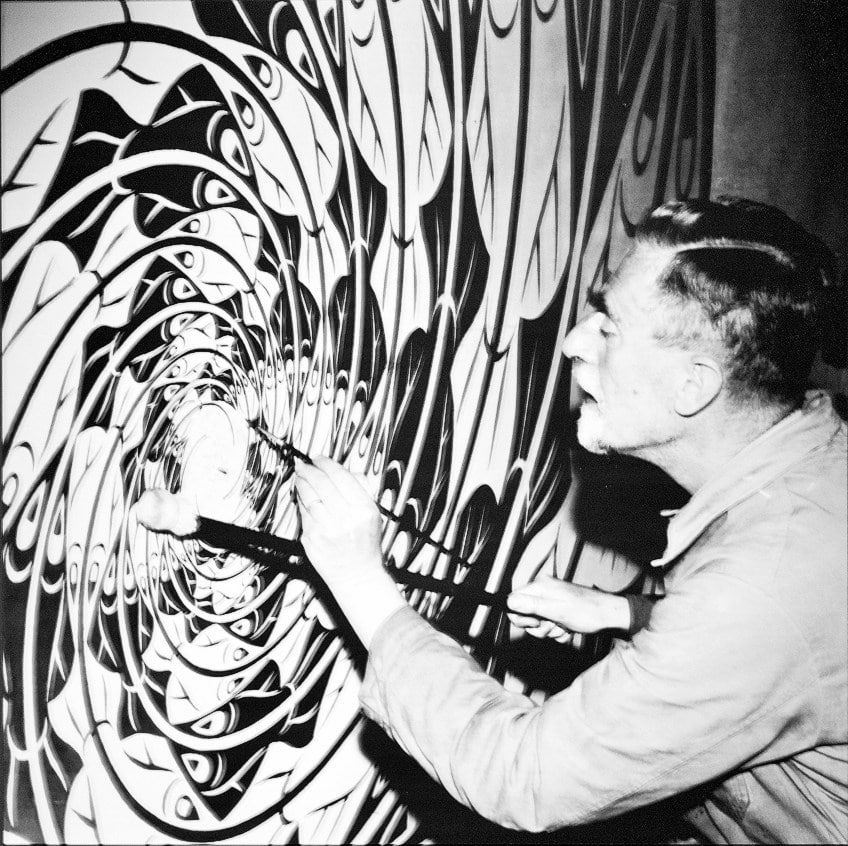 Maurits Cornelis Escher working at his Atelier, 20th century; Pedro Ribeiro Simões from Lisboa, Portugal, CC BY ii.0, via Wikimedia Eatables
In his early on days, he gained great inspiration from the surrounding nature, creating intricate studies of landscapes, insects, and plants. His travels to surrounding European countries such as Spain and Italy led to further studies of architecture and townscapes.
In exquisite places such as the Mezquita of Cordoba and the fortress of Alhambra, Escher found great inspiration from the tiling techniques used in the walls of the architecture. This led to a steadily increasing interest in the mathematical structure of art.
It would also highly influence sure motifs that are at present found in Escher tessellations.
He started exploring the possibilities of using tessellation patterns every bit the bones building blocks for his sketches. From these basic geometric patterns, he and then elaborated their design past turning them into interlocking and circuitous designs featuring motifs such as reptiles, fish, and birds.
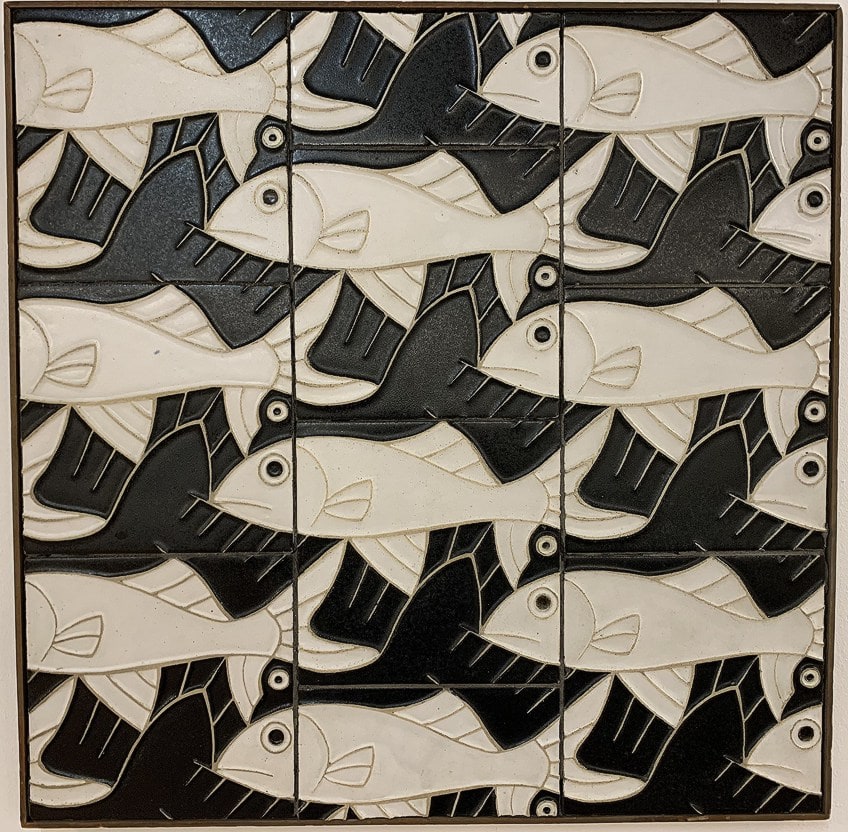 Part of the tile painting Birds and Fishes (1960) by Maurits Escher in the Dutch Tile Museum in Otterlo. The tableau was designed for his home at 59 Dirk Schäferstraat in Amsterdam;HenkvD, CC BY-SA 4.0, via Wikimedia Commons
Study of Regular Sectionalization of the Plane with Reptiles was created in 1939 and was one of his primeval attempts at incorporating geometry into his artwork. He used a hexagonal grid every bit the basis for the construction of the sketch and used information technology equally a reference for his subsequently work in 1943, Reptiles.
In plough, his art became the source of interest for non-artistic types such every bit mathematicians and scientists.
It also started to gain popularity in mainstream mod civilisation after his work featured in the April 1966 edition of the Scientific American journal. Ironically, despite much involvement in his work from the full general public, Escher's art was largely disregarded by the art community itself and a retrospective exhibition for his work only happened after he had already turned 70 years of age.
Koloman Moser (1868 – 1918)
Koloman Moser was built-in in Vienna, Republic of austria on the 30th March 1868. As an artist, he exerted great influence on the graphic art of the 20th century and was a notable figure of the Vienna Secession. He designed a large array of artworks, ranging from fashion textiles to magazine vignettes, stained glass windows, ceramics, jewelry, and furniture.
Drawing on the clean lines and motifs from Roman and Greek art, he sought to move away from the overly ornate way of the Baroque and towards a simplified and repetitive geometric design.
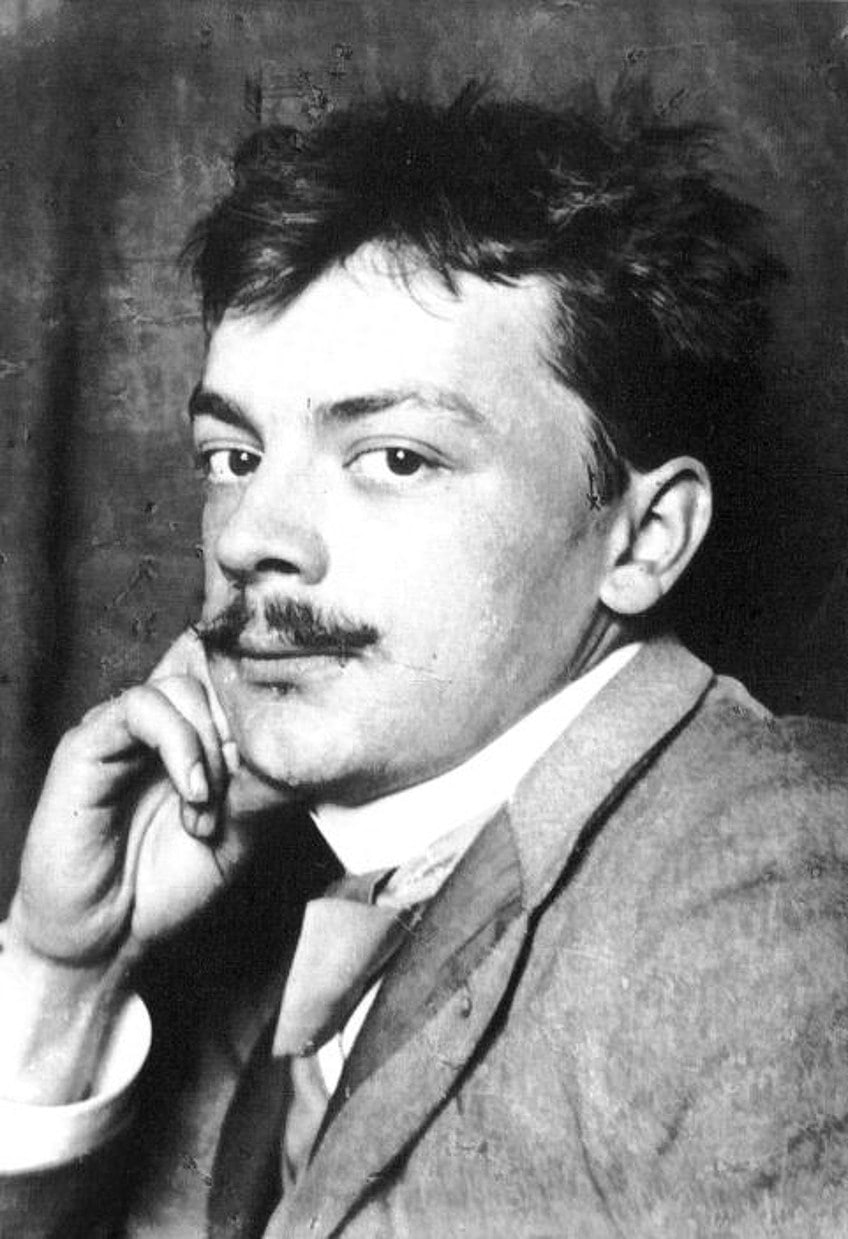 Koloman Moser, 1905;Public Domain, Link
His portfolio Die Quelle, was published around 1901 and featured graceful graphic designs for textiles, fabrics, wallpaper, and tapestries. In 1903 he opened the studio Wiener Werkstätte which created household goods simply designed in an artful also as a practical manner, such as rugs, silverware, and glassware.
He is also noted for his blueprint of the glass windows of the Kirche am Steinhof in Vienna, also as the Alcove mosaic he produced in 1904.
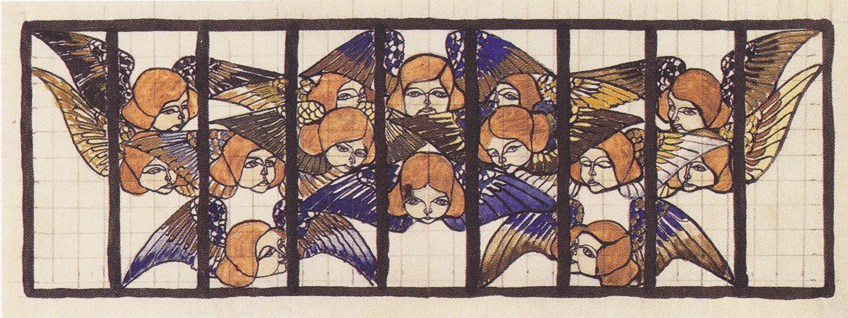 Design for the gallery window of the Kirche am Steinhof church building in Vienna, c. 1905; Koloman Moser, Public domain, via Wikimedia Commons
Along with a fellow member of the Vienna Secession, Gustav Klimt, Moser was a designer for Ver Sacrum, the leading fine art periodical in Austria. The journal was highly regarded for its meticulous attention to item. Examples of his work include Fabric design with floral awakening for Backhausen (1900) and Fabric design for Backhausen (1899).
Hans Hinterreiter (1902 – 1989)
Hans Hinterreiter was built-in in 1902 to a Swiss female parent and Austrian father in Winterthur, Switzerland. He attended the University of Zurich where he studied compages and mathematics as well as music and fine art. It was his mutual honey for the sciences and arts that would influence his work throughout his career. A trip to Espana in his early twenties sparked an interest in the ornamentation and architecture of Moorish culture.
During the mid-1930s, the Spanish Civil War forced him to render dwelling to Switzerland, where he began seriously focusing on his art, and applying the tessellating patterns he had experienced on his travels.
His career highlights include being collected by the Museum of Modern Art, a major institution within the fine art globe. He was also role of the Venice Biennale International Exhibition. Some of his nigh notable works include Opus 64 (1945), Opus 131 D (1977), and SWF 62A (1978).
Famous Tessellation Artworks
Geometric patterns accept been an integral motif in art and compages throughout human history. Let u.s.a. at present look at some of the greatest artworks that display tessellation patterns.
Sky and H2o (1938) – Thou.C. Escher
Sky and H2o was starting time printed from a woodcut in June 1938, by its creator M.C Escher. Birds and fish have been used to separate the aeroplane regularly as the basis of the print. Fitting similar to a jig-saw puzzle, the print displays a horizontal series of the diverse beast motifs, transitioning from i shape to the other in the middle of the print.
In this part, the animals are equally displayed, represented every bit either the background or the foreground, depending on which shade the center of the viewer focuses on. In the center transitionary office, the animals are more just represented, whereas as they extend upward and downward respectively, they become more defined and three-dimensional.
Shah Nematollah Vali Shrine
The Shah Nematollah Vali Shrine tin can exist constitute in Mahan, Iran, and is an aboriginal historical complex that houses the mausoleum of the Iranian poet and mystic, Shah Nematollah Vali. Five years after his decease in 1431, the shrine was created to award him and has since go a site visited by pilgrims on their religious journeys.
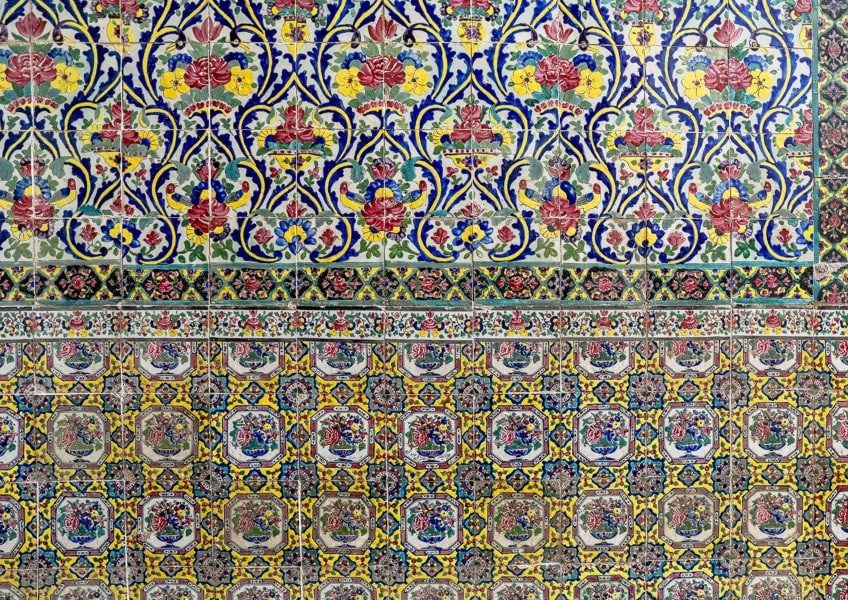 Tilework in the Shah Nematullah Vali Shrine, Mahan, Iran;Ninaras, CC Past 4.0, via Wikimedia Commons
This exquisitely decorated shrine contains iv courtyards, a mosque with twin minarets, and a reflecting puddle. The shrine is covered in turquoise tiles that take been shaped into tessellating patterns. It is considered ane of the nearly beautiful architectural wonders of Persia, with its striking blue dome consisting of stars that repeat and interlace with various formations of stars with a range of five to 11 points per star.
Today we take learned that tessellation fine art refers to the use of repetitive geometric shapes on a plane, without the tiles always crossing over each other, and leaving no spaces or gaps between the tiles. Nosotros take explored how tessellation ideas that originated in ancient Sumeria spread throughout the globe and tin be seen on everything from aboriginal temple walls to modern-day textile designs.
Take a look at our tessellations in art webstory here!
Frequently Asked Questions
Is All of M.C. Escher'due south Work Considered to Be Tessellation Art?
Although Escher was a leading effigy within the fashion and technique of tessellation fine art, not all of his work displays the repetitive use of geometric objects considered to be the hallmarks of what is tessellation art. Many of his works still display a fascination with mathematical concepts simply extended beyond tessellation to include optical illusions, hyperbolic geometry, and the visual representation of impossible objects.
Are People Still Creating Tessellation Art Today?
Yes, many modern artists continue to explore and experiment with tessellation patterns in their artwork, such as Alain Nicolas, Jason Panda, Francine Champagne, Robert Fathauer, Regolo Bizzi, Mike Wilson, and many more than. Patterns will always continue to speak to the core of the homo psyche, as artistic form and mathematical practicality merge to create something memorable and timeless.
0 Response to "Where Are Tessellations Found in Art Where Are Tessellations Found in Nature"
Post a Comment